

© 2020 - 2021 Keen Electronics Limited
e-mail: sales@keenelectronics.co.uk Telephone: 07500 24 11 33
127, New Road, Bromham, Chippenham, Wiltshire, SN15 2JA
Company Registration No: 2613501 VAT Registration No 596069885

Keen Electronics Limited



<< Back to Product
INSTALLATION INSTRUCTIONS - THE DEALER ALARM
INTRODUCTION
The DEALER alarm is straightforward to install, BUT PLEASE TAKE A COUPLE OF MINUTES TO READ THESE INSTRUCTIONS !
The alarm system consists of the following components: -
Control box – with 12 way flying lead with terminal block. The control box can be unplugged after installation for testing/fault finding. The control box can be mounted in any convenient location in the caravan, such as in a bed box with the charger.
Key Fobs – carried by the user/s
Splash proof siren - that can be mounted anywhere - over grille in the floor, behind a ‘fridge grill, or hidden underneath the caravan. Position the siren so the sound can be heard outside the van. Over a hole in the floor is a good location, as a thief cannot get to the wires going to the siren. When mounting over a hole in the floor ensure that the siren is a good fit, so that all of the sound goes through the floor and outside. (It’s no good making a lot of noise in the bed box!!)
PIR head - that should be fitted at eye level "looking down" the caravan’s interior. Avoid fitting where it "looks" straight at a window where possible.
Leg sensor - that should be fitted to the caravan floor adjacent to a rear steady. The magnet is fixed to the spindle so that rotation of the leg winder triggers the alarm.
INSTALLATION
Ensure that the 12Volt leisure battery is disconnected, the mains hook up is disconnected and the 13 pin (or 12S) plug is not plugged into a tow vehicle (or test box).
It’s well worth spending a few minutes deciding where to fit the alarm system’s components. Often wiring can be run at the back of bed boxes and cupboards, which saves drilling through the floor and working underneath the caravan. The wiring diagram shows how the system is connected.
Control box
Once it’s location has been decided screw box to the caravan floor or panel.
Screw the terminal block to the caravan floor or panel so that the 12 way flying lead can be connected neatly between it and the socket on the control box.
Siren
Remove the mounting bracket fixing screws, and then screw the mounting bracket in the desired position. Re-fit the siren body into it’s mounting bracket and re-fit the fixing screws, ensure these are reasonably tight. Use the 2 way terminal block to connect the siren wires to the wires going to the control box. Fix the terminal block to the caravan with a single screw.
PIR Head
This should be mounted at eye level "looking down" the caravan. Usual mounting positions are at the front of the caravan, on either side or in the centre. Avoid mounting the PIR head where it is directly facing a window. Remove the front half of the case by undoing the single screw, then carefully hinging it down and off. Carefully remove the printed circuit board, which is secured by one screw. The PIR head is mounted using the pre-drilled holes in the base. Re-fit the printed circuit board, and then connect the three wires from the control box as shown on the wiring diagram. Refit the front half of the case and secure it with the single fixing screw.
Leg Sensor
This should be fitted to a rear steady with the magnet fixed to the "in board" end of the spindle and the bracket assembly mounted adjacent to it. Rotation of the leg winder should cause the magnet to pass within a couple of milli metres of the sensor fitted to the bracket. Please refer to the diagram.
Clean any grease/road dirt off the part of the spindle that the magnet is to be fixed to. Then stick a double-sided sticky pad onto the magnet, place the magnet onto the spindle then fix in place with the two tyraps. Tighten the tyraps with a pair of pliers - pull hard! Then cut off the surplus plastic from the tyraps. IMPORTANT NOTE – on some caravans the spindle may not be long enough to fasten the magnet onto. In these cases use the grey plastic tube as an extension tube. Simply tap onto the metal spindle using a hammer. Then fix the magnet to the grey tube as described above.
Mount the bracket onto the underside of the caravan floor, positioned so that the magnet passes within a couple of milli metres of the sensor fitted to the bracket. Finally, connect the two wires from the control box to the two used terminals on the leg sensor.

ELECTRICAL CONNECTIONS
Please refer to the wiring diagram at the end of the text.
Connect the leg sensor to the control box using twin flat loudspeaker cable polarity is not important.
Connect the siren to the control box using twin flat loudspeaker cable, observe correct polarity - red siren wire to siren + and black siren wire to siren -.
Connect the PIR head to the control box using the 4-core cable supplied in the kit as shown in the wiring diagram.
Locate a convenient point in the 13 pin (or 12N) wiring to connect to the BRAKE wire - usually red in colour.
Finally, connect the 12 Volt supply from the leisure battery to the control box. Do not use twin flat speaker cable, as it is rather thin for this application. A 0.75mm or 1.0mm cable (24/0.2) or similar is recommended. In some caravans it is practical to connect these wires via the battery charger, but in others it may be easier to connect direct to the leisure battery (always through a 2A in line fuse)
The alarm installation is now complete and ready for testing; ensure that the key switch is in the anti-clockwise (OFF) position. Then re-connect the leisure battery to test the alarm.
TESTING THE ALARM
With the key switch in the control box in the OFF position, check that the PIR detector flashes red when you move in front of it. (Note – when power is first applied there is a 2-minute "warm up" period when the PIR will not detect movement)
Now turn the key switch clockwise, the siren should "cheep" once.
NOTE – when pressing the ON or OFF buttons on the key fobs you need to press the buttons for a couple of seconds.
Press the ON button on the key fob to switch the alarm ON. The siren should cheep twice indicating the alarm is on.
Press the OFF button on the key fob to switch the alarm OFF, the siren should cheep once indicating the alarm is OFF.
Now press the ON button, siren cheeps twice and alarm is ON. Now press both buttons together, siren sounds for 2 minutes, or until OFF button is pressed.
When the alarm is ON any one of the following actions should trigger the alarm sounding the siren instantly:-
Entering the caravan
Winding the "alarmed" rear steady
Hitching up and inserting the 13 pin (or 12N black road lighting) plug
When hitched up removing the 13 pin (or 12N) plug
When hitched up with the 13 pin (or 12N) plug inserted, using the footbrake in the tow vehicle (ignition may need to be turned on)
Once the internal re-chargeable battery has been charged (by the leisure battery), disconnecting the leisure battery.
When the alarm is ON and the alarm is triggered the siren should sound for 2 minutes, unless switched OFF using the OFF button on the key fob.
IMPORTANT NOTE –once the alarm has been triggered the red LED on the control box will stop flashing regularly and will flash a certain number of times, pause, flash the same number of times, etc. The Alarm Status table printed on the control box details number of flashes for each sensor. The LED will continue flashing until the alarm has been reset with the key switch. The LED will revert to normal regular flashing when the alarm is next turned ON. Turning the alarm OFF will then stop the LED flashing. This feature is useful to advise the owners if the alarm has been triggered in their absence and for fault finding (especially intermittent false alarms).
PLEASE NOTE THAT THE COMMON ROAD LIGHTING RETURN (THE WHITE WIRE FROM PIN 3 OF THE 12N PLUG) SHOULD NOT BE CONNECTED TO THE CARAVAN CHASSIS (IN ACCORDANCE WITH NCC RECOMMENDATIONS)
WHEN TESTING THE ALARM’S 12N PLUG OPERATION PLEASE NOTE THAT THE VAN MUST BE COUPLED TO THE TOW VEHICLE (That is, the tow head of the caravan must be on the tow ball of the tow car).
IMPORTANT NOTE ONLY APPLICABLE TO CARAVANS WITH 12N & 12S PLUGS – if the caravan is fitted with a stabiliser using fibre pads an electrical connection will not be made through the tow ball. This will prevent the alarm from being triggered when the 12N plug is inserted. The alarm will however be triggered when the 12S plug is inserted (as well as the 12N plug). A way round this problem is to insert some conductive metal gauze (wire wool scouring pad) into the cup of the tow head. Should a thief hitch up a connection should be made through the metal gauze.

DEALER ONE PLUG CONNECTIONS - ALARMS WITH 10 PIN PLUGS

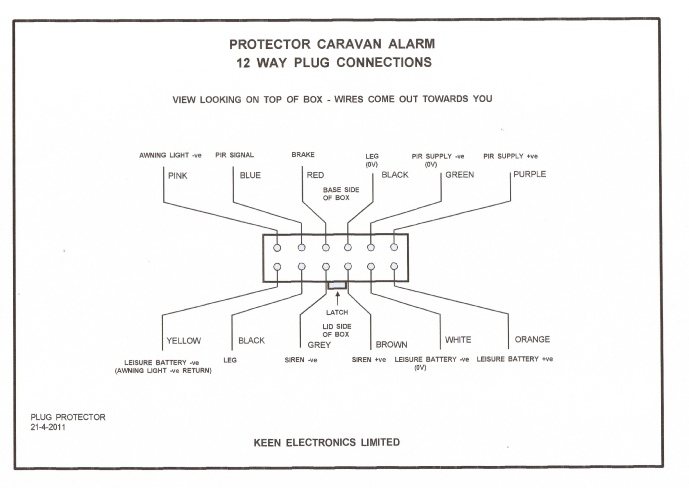
DEALER TWO PLUG CONNECTIONS - ALARMS WITH 12 WAY PLUGS
CONNECTIONS ARE THE SAME AS THE PROTECTOR ALARM BELOW
For DEALER ONE please scroll down